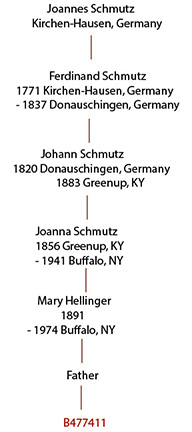
In addition there is at least one other person with a Schmutz ancestor who has done autosomal DNA testing and does not have an identifiable Schmutz match in the FTDNA database. Her family settled in Kentucky, and immigrated from Germany.
Schmutz Lines of Descent
brief highlights pertaining to Schmutz Family genealogy and the publicly posted DNA results from the Schmutz DNA project
This webpage was first posted on November 29, 2008 and last updated on August 30, 2026 by Sheila (nee Stark) Schmutz sheilamschmutz@gmail.com (It was moved to this server on June 2, 2023.)
This is a private webpage that provides information in support of the Schmutz Surname Project at FTDNA. Data from other such companies is included when publicly available or provided by a participant. Please address corrections and additions to her.
To me, genealogy is the study of family history and heritage across time and geography. Genealogy involves sociology, history, geology and perhaps psychology but not necessarily biology. Y DNA is bare bones biology. It provides no context or interpretation of indication of the caring relationships in families. It should therefore not be surprising that the results of genealogical studies and Y DNA studies will not always be in perfect agreement. A difference in biology does not negate our shared heritage.
The drawings below are an attempt to capture some of this information in a visual format. Some of the drawings simply shows one line of descent from an ancestor through males. That is because Y DNA can only be used for males descended from males.
Although this project began focusing only on Y DNA, it has been expanded to included autosomal DNA. The autosomal DNA test at FTDNA is called Family Finder but other companies such as Ancestry, do not use this name. Persons in the charts below that have FF followed by initials have done an autosomal DNA test. They sometimes link through a female Schmutz ancestor therefore.
The DNA data thus far suggests that the Schmutz name, with a "meaning", was adopted by more than one man. There are at least Three Schmutz families represented by DNA testing as of 2017:
I have chosen to refer to these families by a place that an ancestor lived before 1800. This does not suggest that all members of that family lived there, however.
|
In addition there is at least one other person with a Schmutz ancestor who has done autosomal DNA testing and does not have an identifiable Schmutz match in the FTDNA database. Her family settled in Kentucky, and immigrated from Germany. |
|
Schmutz is a common name in Switzerland. The lineage charts below shows two Schmutz men who settled in Utah that descend from a Swiss ancestor. Both men match at Y DNA markers tested by the former Sorenson Molecular Genetics, and the transferred results are also shown. Another man with a variant spelling of Schmutz was tested in 2019, B463676. Another Schmutz man did Y testing in fall 2022, Kit 987417. All r men are considered a "close" match at 25 markers by FTDNA criteria. However Sorenson did not test all the markers between 26 and 37 and the two men tested by FTDNA have more differences than FTDNA would classify as a "close match". The marker data is shown below.

One woman has done a Family Finder test in 2016 who has an ancestor, Abraham Schmutz who was born in Switzerland in 1697 and immigrated first to Holland and then to the USA in 1742. He died in the U.S. in 1776. In turn she has a Family Finder match to a man who has an ancestor from Bern Switzerland in the 1500s. His autosomal DNA test was done by Ancestry and the results transferred to FTDNA. He has a Family Finder Match to a person who shares a common ancestor with him.
Based on these data, it seems that this is one very large Schmutz family that lived in the area of Bern Switzerland for centuries, even though their common ancestor has not yet been identified. It will therefore be called the Bern Schmutz Family

Schmutz Ancestors from Germany and France
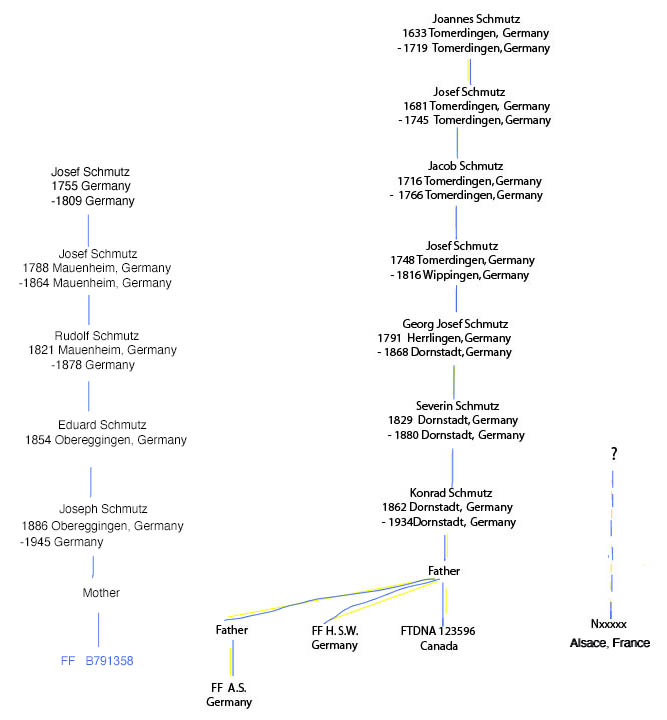 |
So far 2 men named Schmutz match in this group. One settled in Canada, but all of his known ancestors back to about 1700, were in Germany. See his line at the left. His Y DNA haplotype is very different from the two men above with a Swiss ancestor. He, and some of his close relatives took the Family Finder autosomal DNA test in 2017. Their DNA indicates the expected close relationships. FF before initials, indicates the person took a Family Finder test. This test works equally well on males and females. This Schmutz family is being called the Dornstadt Schmutz Family, since some of their ancestors lived in that village in Germany before 1800. The documentation for this German line is shown in this pdf. In 2026, another man matched some of these Schmutz persons with Family Finder. His mother was born in Germany but emigrated to the United States after her Schmutz father died. Thus far I have not found their common ancestor, presumably further back than either line is shown. Obereggingen is part of Ulm, near Dornstadt. |

Matricula is an online database of Catholic church records in Germany. Some records can be found there related to Dornstadt: https://data.matricula-online.eu/de/deutschland/rottenburg-stuttgart/dornstadt/ There are also some records for Tomerdingen: https://data.matricula-online.eu/de/deutschland/rottenburg-stuttgart/tomerdingen The Tomerdingen records are not available on Family Search any longer, although they used to be.
|
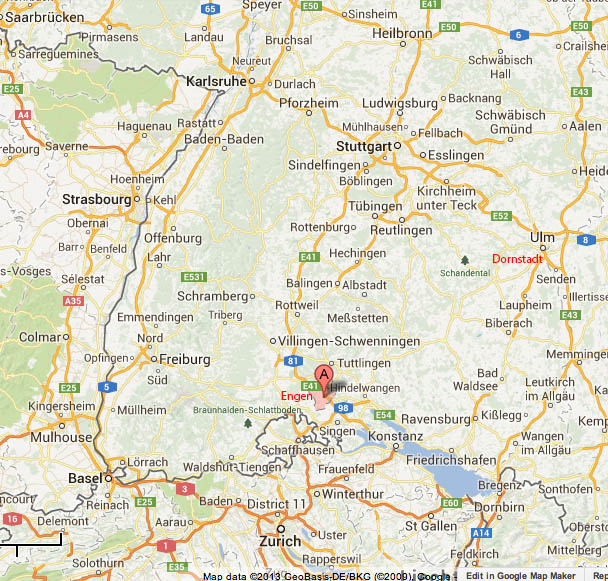
Another Mr. Schmutz is a 12/12 match to the one who emigrated from Germany to Canada. He is living in France, in the Alsace region along the border with Germany. His recent ancestors lived in Mulhouse. A Dominique Schmutz who was a locksmith lived in Colmar in Alsace from 1714 to 1800. This is based on a document entitled "Chronique du serrurier Dominique Schmutz de Colmar, 1714-1800" by Dom Schmutz and Joseph Liblin, published in Mulhouse in 1874. There is a copy in the library in Strasbourg, but I have not seen it. The map at the right shows Alsace in France and part of the adjacent Baden-Wurtemburg in Germany. The ancestors of these men did not live far apart by today's standards, but quite a distance apart by the travel of the 1700s. |
 |
There were other Schmutz families in Dornstadt who may or may not be related to the participant or each other. It would seem likely that at least some are related. These data on these Familienregister pages was found on FHL International Film 1053443, "Kirchenbuch, 1702-1902, Katholische Kirche Dornstadt (OA. Blaubeuren)" and were transcribed by Sheila Schmutz in May 2009.
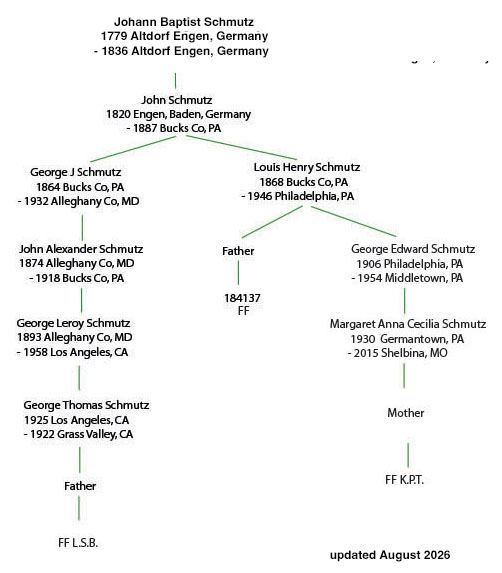 |
Another man named Schmutz had ancestors who also came from Baden-Württemberg, but they settled in Pennsylvania. See his line at the left. He does not match the other Schmutz men tested so far. A Family Finder test has also been done on his DNA. This family also has some others who have done the Family Finder test and their lines are shown on the chart also. These data help confirm that this is a separate Schmutz family, because they don't match the other people in the Swiss or other German family. This family is being called the Engen Schmmutz Family because some of the ancestors in Germany before 1800 lived near this town. |

Matricula is an online database of Catholic church records in Germany. Some records can be found there, such as the death record of Johann Baptist Schmutz in 1836, at 56 years of age. One must figure out the church and diocese though. The records are handwritten in old German script, so they can be difficult to read.
Schmutz Family Locations in 1995
| Country | Number of Households | Most Common State/Province |
|---|---|---|
| Australia | 2 | New South Wales |
| Austria | 240 | Niederoesterrich |
| Canada | 17 | Ontario |
| Germany | 390 | Baden-Wuerttermberg |
| Great Britain | 0 | - |
| New Zealand | 1 | North Island |
| Switzerland | 1,517 | Bern |
| United States | 324 | Utah |
The information in the table above is from "The World Book of Schmutzes" published by Halbert's Family Heritage in the U.S.A. in 1995, through a mail order promotion. The data are known to be incomplete but they may indicate an approximate proportional distribution of Schmutz families at that time.
Immigrants to North America
A partial listing of Schmutz immigrants is on a separate page.
Links to Sites about Country of Origin
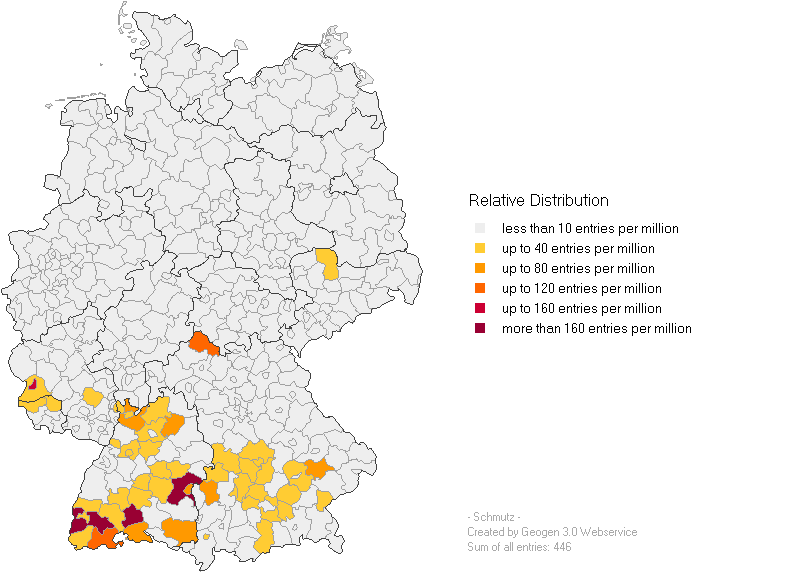 |
GeoGen A database that is searchable by Surname and shows both the proportional distribution of current residences with that name as head of household and the actual number for earch province in Germany |
|
On a Schmutz message board at RootsWeb from 2000, Dave Schmutz stated that there were 16 villages in Switzerland which had Schmutz families before 1800 and refers to a website with a map. Sadly this website is now down since 2004. If someone has a copy of that map, I'd be happy to post it here. In the meantime here is a map of Germany, Switzerland and Austria from www.Atlapedia.com |
 |
Links to Sites with Schmutz Family Genealogy Data and History
Genealogical information can be supported or confirmed by Y DNA data. However Y DNA data alone can not trace ancestry. Unfortunately most websites with genealogical data from Germany and Switzerland are no longer available. Some attribute this to the 2018 European privacy changes.
GedBas: Die genealogische Databasis A searchable database that allows free access to genealogies submitted by people in Germany. Although the site is in German, it's as easy to use Suche as Search.
Links to Other Related Sites about Y DNA
Aims and Limitations of this Webpage
In the fall of 2008, a few people interested in Schmutz family genealogy began corresponding about confirming the genealogical data many people have both individually and jointly collected, using Y DNA. I will do my best to update the page periodically, using the information posted on public websites.
Note that the names of the participants and their Fathers are not shown to protect the privacy of the individuals. If individuals do not wish their line to be shown at all, please contact me and I will respect your wishes.
FTDNA provides estimates of the average MAXIMUM distance to a common ancestor based on the number of markers that are different between two men, or alternatively on the cumulative number differences across the markers. The microsatellie markers chosen for testing by these various companies are prone to mutation and that's why they work well for studies of migration and genealogy. Microsatellite markers are runs of repeats - 12, 13, 14 CT or AG in a row, for example. Occasionally a microsatellite will not occur in an individual and this is called a null allele. It only takes a single deletion to eliminate a microsatellite and so a score of 0 is really of no greater significance than a difference of 12 and 13. Both types of mutation have been seen in Y DNA studies.
One should not expect to take these estimates of distance literally in a specific family. A mutation happens, when it happens. This can be between a father and his son, even though the estimated distance stated on the FTDNA charts is much longer than a single generation.
Participants should participate with the full knowledge that they may find out that they do not match the ancestor they expected to. This can be a heart wrenching experience. Many families have adopted children over the years and these adoptions were not openly discussed in some periods, as they are now. Giving the child the name of its adopted family was considered the norm and a sign of the strong esteem in which the child was held. Also see this excellent webpage on "paternity events".
This webpage is part of a series of genealory pages compiled by Sheila Schmutz. Please contact her sheila.schmutz@gmail.com